
Steel Wedges for Structural Leveling & Tensioning of Support Beams
The dimensionally stable leveling solution for structural engineers, architects, and steel builders.
When placing steel or wooden support beams (such as IPE, HEA, HEB, or UNP profiles), dimensional tolerances, sloped bearings, and settlement are inevitable. To bring a structure exactly to the desired level and eliminate calculated deflection and settlement, Euronique’s solid C45 steel wedges are the industry standard.
No spring-back effect, no risk of breakage, and guaranteed maintenance of pre-tension under heavy permanent loads.
- C45 Structural Steel (1.0503): Extremely high compressive strength and resistance to deformation
- Structurally Safe: Prevents settlement, play, and cracking in overlying masonry or floors
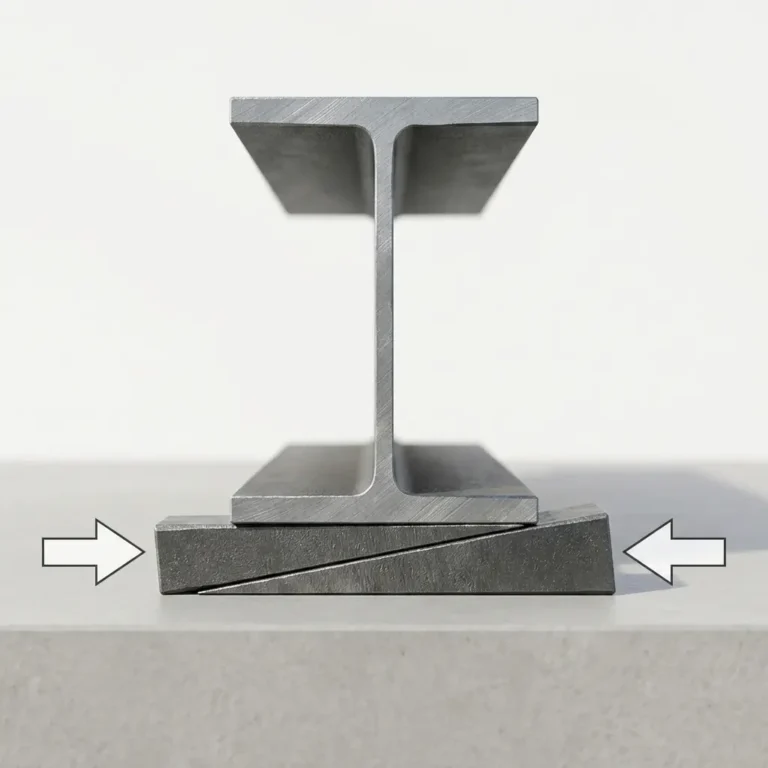
- Infinitely Adjustable Leveling and Tensioning: Forms an exact horizontal, beam-covering platform (counter-wedge method)
- Suitable for Specifications & Calculations: Meets the requirements of structural engineers and architects for heavy-duty bearings
- Universally Applicable: IPE, HEA, HEB, HEM, UNP, hollow sections, and column base plates
- Directly from Stock: Fast delivery to the construction site or workshop
As a work planner, structural engineer, or architect, you want to be able to act quickly without hassle. Are you looking for high-quality steel wedges or leveling shims for construction, mechanical engineering, or heavy industry? You have come to the right place at Euronique. We deliver industrial-quality precision wedges directly from stock or custom-made to your specifications.
Whether you want to buy a small batch of steel wedges immediately or order large volumes on account: we ensure your project suffers no delays.
or email your request to info@euronique.nl
Structural Safety with Steel Wedges when Leveling Support Beams
For architects and structural engineers, one thing is paramount: the correct transfer of forces without unwanted deformation or settlement. For installers on the construction site, it is about working quickly, accurately, and safely.
Filling and leveling support beams on concrete foundations, masonry piers, or steel structures presents specific structural challenges:
- Point loading due to uneven surfaces: Concrete and masonry are never 100% flat. Without the correct, flat support, a dangerous concentration of forces occurs on the flange edges.
- Risk of buckling and tilting with narrow flanges: Profiles with a narrow flange (such as IPE or UNP beams) require a stable, wide bearing during the leveling and assembly phase.
- Settlement and cracking due to lack of pre-tension: When a beam is merely placed ‘loose’ at height, the structure will sink when the dead load is applied. This leads to play and cracking in the overlying finish.
- Failure of soft leveling materials: Plastic shims or wooden wedges crush or deform under tons of heavy pressure from HEA or HEB profiles. This leads to unacceptable dimensional deviations and structural rejection.
The Solution: Infinitely Adjustable Leveling and Tensioning (Counter-Wedge Method)
To meet structural requirements and align the beam with millimeter precision, C45 steel shims are used in an opposing arrangement (counter-wedges).
- Infinitely Adjustable Height Setting (Leveling)
By driving two identical, tapered wedges from opposite directions under the beam head or base plate, you cancel out the slope. This creates a 100% horizontal, beam-covering platform that is infinitely adjustable to the exact millimeter height.
- Active Tensioning (Pre-tensioning)
By forcefully striking the counter-wedges with a hammer, you force an active pre-tension between the bearing and the overlying structure. All elastic play is immediately pushed out of the chain. The result: Zero settlement when the full weight of the renovation comes to rest on the beam.
Why Structural Engineers Choose Wedges and Shims made of C45 Steel (1.0503)
Not every steel block is suitable as a structural leveling tool. Euronique produces leveling wedges from C45 quality steel (1.0503). This offers specific material-technical advantages that are indispensable in static calculations:
- Self-locking slope angle (no risk of shearing): Euronique’s C45 wedges are sawn at a safe self-locking angle. Due to this specific angle, the wedges can never ‘walk’ or slip back under extreme pressure or vibration. The frictional resistance ensures that the leveling structure remains absolutely dimensionally stable.
- High yield strength and compressive strength: C45 steel does not fail or dent under the extremely high point and line loads of heavy wide-flange beams (HEB/HEM).
- Tough and break-resistant: Unlike hardened tool steel, C45 is tough enough not to splinter or break when struck forcefully on the construction site.
- Excellent weldability (Tack welding): C45 can be excellently fixed with a tack weld to the beam flange or base plate to absorb vibrations.
- Guaranteed material value: Assurance for the structural engineer that the leveling tool meets the expected load.
Leave Steel Leveling Wedges Under the Support Beam or Remove Them?
A frequently asked question from both lead structural engineers and contractors: “Can the C45 steel wedges remain under the beam after leveling, or must they be removed after dry packing?”
The answer depends on the project requirements and the processing method on site:
Option A: Temporary Use & Removal After Curing (Recommended for corrosion risk & reuse)
Advice: Remove after the mortar has cured.
How does this work? The C45 steel wedges are used to level the support beam with millimeter precision and to apply tension. Subsequently, the space under the beam flange or base plate is filled with non-shrink dry pack mortar. Once the mortar has fully cured and taken over the structural load-bearing capacity, you simply tap the steel leveling wedges loose.
The advantage: You definitively eliminate any risk of friction or contact corrosion between the wedge and the beam flange. Furthermore, the solid C45 wedges can be reused immediately for a subsequent leveling project.
Option B: Permanent Embedding in Dry Pack Mortar (Fully Enclosed)
Advice: Leave in place, provided they are 100% enclosed.
Are the wedges fully cast or packed in the mortar? The high pH value (alkalinity) of cement-based mortar passivates the steel. As long as moisture and oxygen are completely excluded, the wedge forms a permanent, corrosion-free part of the foundation.
Important note for installers (Removal vs. Retention in case of moisture & corrosion risk):
If the wedges are left in place, can the complete exclusion of moisture and oxygen not be 100% guaranteed? (For example, due to crevice formation, air bubbles/voids in the mortar, or in damp outdoor applications):
Choose removal after curing: Remove the C45 steel leveling wedges as soon as the dry pack mortar has reached its strength. Immediately fill the remaining recesses with mortar. This is the safest method to prevent crevice and contact corrosion between the steel of the beam and the wedge.
Preservation when leaving in place: If the wedges cannot or may not be removed, pre-treat the C45 wedges and the contact surfaces of the beam flange with a zinc-rich primer or anti-corrosion coating.
Compaction & Sealing: When casting, use a high-flow, non-shrink grout to prevent ‘air pockets’, or seal the outer edges after curing with a suitable hybrid sealant so that capillary moisture has no chance to creep between the contact surfaces.
Leveling and Tensioning Support Beams: 5 Guidelines for Steel Shims
- Always apply the counter-wedge method: Always use two wedges in pairs to guarantee a parallel bearing surface and prevent point loading.
- Actively tension the beam: Strike the wedges forcefully until the play has completely disappeared. This prevents later settlement of the overlying floor or roof.
- Place the wedges directly under the web: The stiffness of support beams (IPE/HEA) lies in the vertical web. Place the wedges as close as possible under the centerline of the web to prevent deformation of the flange edges.
- Secure against vibrations: Apply a small tack weld between the two C45 wedges once the desired tension and height have been reached.
- Match the width to the flange width: For wide flanges (such as HEB or HEM), choose a wider C45 wedge to distribute the compressive stress over as large an area as possible.
Directly Available Range of C45 Steel Leveling Wedges
Contractors and steel builders deal with tight schedules. Euronique delivers tapered C45 leveling wedges directly from its own stock.
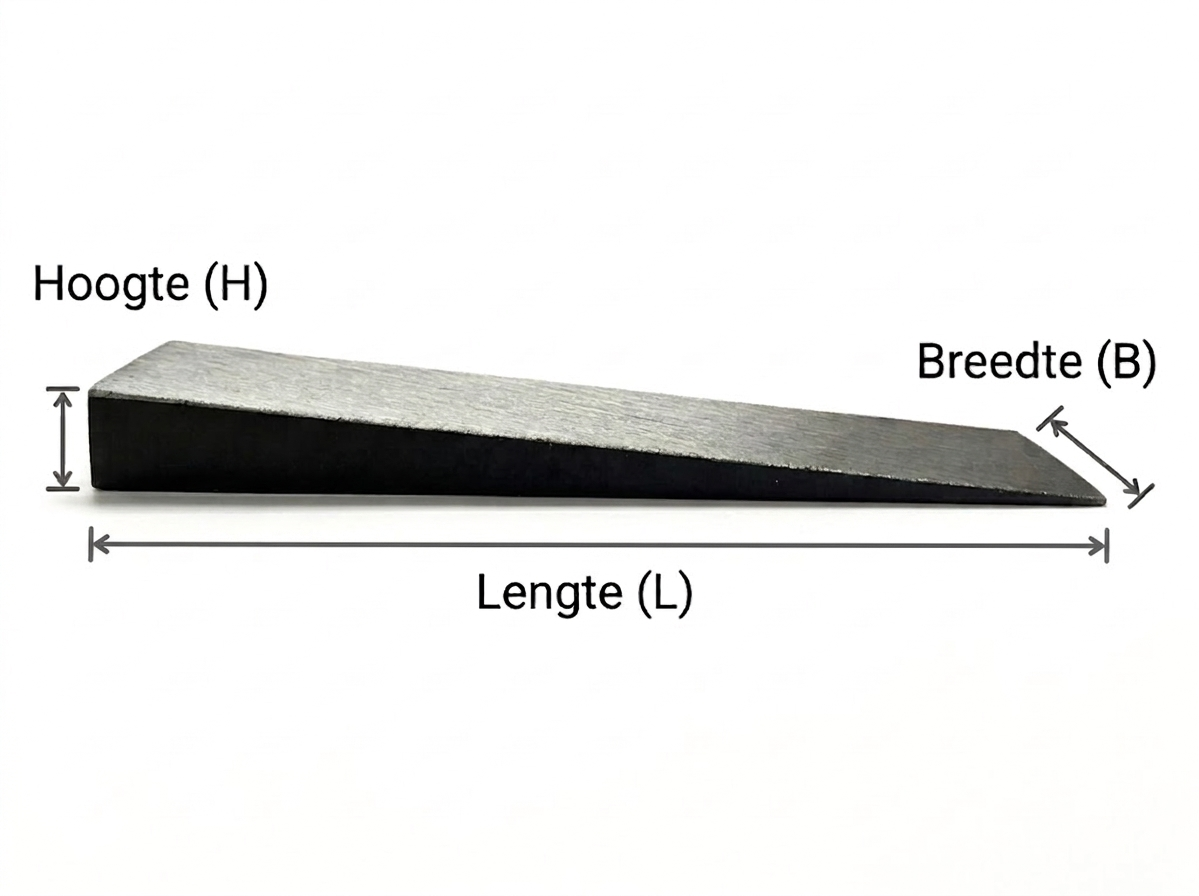
| Width (mm) | Length (mm) | Height range (mm) | Material | Suitable for e.g. | Action |
|---|---|---|---|---|---|
| 20 mm | 100 mm | 1 → 10 mm | C45 Steel | Tubes, angles, light IPE | View Product |
| 25 mm | 150 mm | 1 → 13 mm | C45 Steel | IPE 140-220, HEA 100-160, UNP | View Product |
| 40 mm | 200 mm | 1 → 20 mm | C45 Steel | Heavy IPE, HEA 200+, HEB profiles | View Product |
| 40 mm | 250 mm | 1 → 25 mm | C45 Steel | Heavy HEB/HEM & heavy steel construction | View Product |
| 50 mm | 300 mm | 1 → 25 mm | C45 Steel | Heavy HEB/HEM & column base plates | View Product |
Are the desired dimensions or slope angles not in the overview? Euronique also supplies custom C45 leveling wedges for specific project requirements via info@euronique.nl.
Frequently Asked Questions about Steel Wedges (FAQ)
Which support beams can I level with these wedges?
Our C45 steel wedges are universally applicable for almost all steel profiles, including IPE, HEA, HEB, HEM, UNP, angle steel, and hollow sections, as well as for shimming column base plates.
Why C45 steel instead of standard S235 structural steel?
C45 steel has a higher yield strength and hardness than standard S235. As a result, the wedges do not deform under extremely heavy point loads from solid beams, and the infinite adjustability is maintained.


